It Starts With Me - Day 5

Antiha's 7-day exploration of "It Starts With Me". Join us for practical tips on reacting to outrage culture and using Jesus' teachings on love, peace, and forgiveness to resist hate.

Day 5 - Heart-change vs. Winning

By Chris Richards
Founder, Antiha.org
Published March 12, 2026

Note: I've written two versions of this article. Message me to let me know which you prefer: info@antiha.org

Article 1

[HERO] Day 5: Heart-change vs. Winning

Field Order 05: The Objective Shift

In the theater of digital discourse and modern outrage, we have been trained to mistake a "shut down" for a "win." We treat dialogue like a zero-sum game where the goal is the intellectual decapitation of the opponent. If they stop responding, if they are ratioed into oblivion, or if they are shamed into silence, we mark it as a victory for the Truth.

But here is the reality check: you can win every argument and lose every person.

In the Kingdom of God, victory isn't measured by the humiliation of an image-bearer; it is measured by reconciliation. If your "win" leaves a trail of resentment and deeper entrenchment in the other person’s soul, you haven't advanced the cause of Christ. You’ve just successfully defended your own ego. Today, we move from the tactical action of the tongue to the strategic objective of the soul.

Tactical Emphasis: Ephphatha (ܐܶܬ݂ܦܬܰܚ / “Be opened”). What is the posture of the Kingdom in a tense exchange: “shut them down,” or “open them up”? The world’s doctrine is closure: silence the enemy, freeze the relationship, seal the verdict. Jesus’ field command is the opposite: Ephphatha—not “be defeated,” not “be exposed,” but be opened.

That matters because Greek terms like metanoia describe the result we pray for (a mind/heart turned around). Ephphatha names the posture and approach we take to get out of the Spirit’s way: we aim for a neighbor’s heart to be opened, not an opponent’s mouth to be closed. If your “win” shuts a person down, it’s not a Kingdom win—it’s just a clean kill shot in the comment section. Uh-hum, literally.

1. The Jurisdiction of the Heart (Lēb)

To understand why "winning" is a secondary goal, we have to look at the anatomy of the human person. In the Hebrew tradition, the heart (lēb) is not just the seat of "warm feelings" or Hallmark-card sentimentality. The lēb is the command center of the entire human experience: it is where the intellect, the will, and the emotions intersect to make choices.

When we engage in outrage culture, we usually target the intellect. We throw facts, logic, and "gotcha" verses like stones. But human arguments cannot penetrate the lēb. You can force someone to admit a logical inconsistency, but you cannot force them to love the truth. Only the Holy Spirit has the jurisdiction to swap a "heart of stone" for a "heart of flesh" (Ezekiel 36:26).

Scripture Check: "For Yahweh doesn’t see as man sees; for man looks at the outward appearance, but Yahweh looks at the heart." (1 Samuel 16:7, WEBUS).

If God’s primary focus is the heart, then ours should be too. If our engagement doesn't leave room for the heart to move, we are essentially trying to do a job that we aren't authorized to do. We are busy trying to fix the "outward appearance" of agreement while the internal engine is still seized with bitterness.

A stone heart breaking away to reveal a heart of light, symbolizing biblical transformation over outward agreement.

2. The Futility of Intellectual Compliance

There is a massive difference between winning a debate and witnessing a Metanoia (μετάνοια). Metanoia is a radical change of mind and heart: a total reorientation of one's life toward the light.

But if metanoia is the destination, what’s the field command that keeps you from turning the conversation into a chokehold? In Jesus’ own Aramaic-speaking context, we have a blunt, boots-on-the-ground imperative: Ephphatha—“Be opened.” (Mark 7:34). That’s not a vibe. That’s an order.

Outrage culture doesn't want metanoia; it wants compliance. It wants the other person to "bend the knee" to the prevailing narrative. But forced agreement isn't faith. It’s just survival. If you browbeat a neighbor into silence through superior rhetoric or social pressure, you haven't gained a brother; you’ve created a more sophisticated and resentful opponent.

Operational Contrast: the world tries to “shut down” an enemy. Jesus tells you to treat a neighbor like a stuck door, not a target: Ephphatha. You don’t win hearts by slamming them; you win hearts by refusing to add more locks. The Spirit handles metanoia. Your assignment is to keep the environment open enough for it to happen.

Fun Fact: Did you know that when people feel attacked, their brains often enter "fight or flight" mode? This actually shuts down the prefrontal cortex: the part of the brain responsible for logical reasoning. So, the harder you "attack" with logic, the less likely the other person is to actually process it. Uh-hum, literally.

True Kingdom impact requires that the other person be "won over" (peithō), not just defeated. This requires a level of gentleness that the world mistakes for weakness.

Scripture Check: "And the Lord’s servant must not quarrel, but be gentle towards all... in gentleness correcting those who oppose him: if perhaps God may give them repentance unto the knowledge of the truth." (2 Timothy 2:24-25, WEBUS).

Notice the order of operations there. Gentleness comes first. God grants the repentance. You are just the delivery system, not the source of the change.

3. The Moral Danger of the "Win"

There is a specific kind of spiritual poison that comes from being "right." When we are certain we have the moral high ground, we often feel entitled to use the Truth as a club. We dehumanize the person on the other side of the screen because they are "wrong," and therefore, they deserve the "burn."

But if our "victory" results in the dehumanization of someone created in the image of God, it is a moral defeat in the eyes of Heaven. We are warned that the tongue is a fire, a restless evil, full of deadly poison (James 3:8). If we use that fire to burn down a neighbor's dignity just to prove a point, we are playing with matches in a gas station.

Scripture Check: "He who is slow to anger is better than the mighty; and he who rules his spirit, than he who takes a city." (Proverbs 16:32, WEBUS).

Winning the argument is like "taking a city." It looks impressive on a map. But if you haven't ruled your own spirit: if you've let contempt and pride take the lead: then that city is just a pile of ashes. You’ve "won" a graveyard.

4. Radical Love as a Tactical Advantage

The world expects you to strike back. It expects you to defend your "side" with everything you've got. When you choose not to win: when you choose to prioritize the relationship over the retort: you disrupt the entire cycle of outrage. This is the essence of enemy love.

Jesus didn't come to win an argument against the Pharisees; He came to offer them a new way of being, even while they were trying to trap Him in His words. He was willing to be misunderstood and even "lose" the ultimate legal battle on the Cross so that the world might be reconciled to the Father.

We are called to be ambassadors of reconciliation, not lead prosecutors. An ambassador doesn't go to a foreign land to win arguments; they go to represent the interests of their King and to keep the lines of communication open.

Scripture Check: "Therefore, putting away all filthiness and overflowing of wickedness, receive with meekness the implanted word, which is able to save your souls." (James 1:21, ASV).

"Meekness" here is prautēs: strength under control. It is the ability to have the better argument but the restraint to keep it in check for the sake of the other person's soul.

Clasped hands and an olive branch representing peace and reconciliation, prioritizing relationships over winning. heart-divided-blue-red-reconciliation-cross.png

5. Practical Application: Losing to Win

How do we actually do this in the wild? How do we prioritize heart-change over score-keeping?

  1. Check Your Vitals: Before you hit "post" or "send," ask yourself: "Am I trying to help this person see the Light, or am I just trying to see them fail?" If it's the latter, put the phone down.
  2. Affirm the Image: Find something in the other person's position: even if it's small: that reflects a desire for justice, truth, or goodness. Acknowledge their humanity before you address their theology.
  3. Leave a "Way Out": Don't back people into a corner where the only way out is total humiliation. Give them space to change their mind without losing their dignity.
  4. Embrace the Silence: Sometimes the most powerful way to "win" a heart is to refuse to participate in the fight. Like a perfectly tuned in an orchestra, sometimes the beauty is in the clarity of a single note rather than the volume of the whole section. Reconciliation, much like music, requires harmony, not just noise.

Scripture Check: "For what does it profit a man, if he gains the whole world, and forfeits his life?" (Matthew 16:26, ASV).

In a digital context: What does it profit you to win the thread but lose your soul to the spirit of contempt?

The Bottom Line

Our goal is not to have the last word. Our goal is to point people toward the Living Word. If our neighbor leaves an interaction with us feeling smaller, more hated, and more alienated, we have failed: no matter how "correct" our facts were.

We are playing for the long game. We are playing for the restoration of all things. That doesn't happen through rhetorical dominance; it happens through radical, sacrificial love. It starts with a heart that values the person more than the point.

It Starts With Me. Not Left. Not Right. Anti-Hate.

[LOGO] Antiha

Day 5 - Heart-change vs. Winning

By Chris Richards
Founder, Antiha.org
Published March 12, 2026

Note: I've written two versions of this article. Message me to let me know which you prefer: info@antiha.org
Article 2

Day 5 - Heart Change vs. Winning

Two adults at a small kitchen table at dusk, one mug of tea between them and a phone face-down, warm window light, guarded but not hostile expressions

Hey there, I’m Chris.

There’s a kind of victory that leaves a bruise. You feel it most clearly after the moment has passed—after the thread is closed, after the conversation ends, after you’ve walked to your car with your heart still revving. In the moment, “winning” can feel like oxygen. Your point was sharper. Your logic was cleaner. Their argument had holes and you found them. Maybe people even watched it happen and, in their own quiet way, rewarded you for it. But later, when the house goes still, you can sense what the win cost. The person across from you isn’t closer. They’re farther. And even if you tell yourself you were defending what’s true, there’s a question you can’t shake: if truth is supposed to make us free, why do I feel more trapped—more tense, more brittle, more suspicious—after I “won”?

Abstract minimalist cracked-stone heart outline with a thin seam of warm light breaking through, cinematic contrast

Part of the answer is that the real battleground isn’t the comment section or the dinner table. It’s the heart—or, more precisely, what Scripture treats as the jurisdiction of the heart: Lēb (לֵב). Not the heart as greeting-card sentiment, but the inner command center where desire, will, memory, and loyalty get sorted out when pressure hits. That’s why “winning” can feel so satisfying in the moment and still leave you hollow afterward: you may have gained a point, but you also practiced becoming a certain kind of person while you got it. And those practices add up. If I choose contempt often enough, contempt stops being a mood and becomes a posture. It shows up dressed as realism—“I’m just telling it like it is”—but what it’s really doing is shrinking my capacity to see another human being as anything other than a problem to crush. This is one of the quieter spiritual dangers of our age: you can be “right” in ways that look impressive in public, and still be slowly training your inner life to feed on disgust, as if disgust were proof of discernment instead of a warning light on the dashboard.

Plain paper name tags reading “MAGA,” “Libtard,” “Fascist,” “Marxist” on a table as hands gently remove one label, warm documentary light

That disgust is the moment a person becomes a shortcut. Not a neighbor with a story, not a complicated soul with fear and longing and blind spots, but a cardboard cutout: the “MAGA” relative, the “Libtard” neighbor, the “Fascist” coworker, the “Marxist” stranger online. Labels do what they’re designed to do: they save time, they spare you from curiosity, and they let you skip the slow, unsettling work of admitting that the person you can’t stand is still a person. Christianity pushes back against that shortcut with a stubborn claim: human beings are image-bearers of God—Imago Dei (צֶלֶם אֱלֹהִים). That doesn’t baptize bad ideas or excuse harm, and it doesn’t mean boundaries disappear. It means you don’t get to erase someone’s humanity because it would make your argument easier or your anger feel cleaner. It also means that whenever I reduce someone to a label, I’m not only doing violence to them—I’m dulling my own ability to recognize the image of God at all, because contempt doesn’t stay contained; it spills into how I treat the next person, and then the next, until my world is filled with “types” and almost nobody feels real anymore.

And this is where we run into the futility of intellectual browbeating. You can press someone into “agreeing” with you and still never touch the Lēb (לֵב). In fact, the harder you push, the more you often get what looks like compliance but is really retreat—someone saying “Fine” because they want out of the room, not because anything inside them has shifted. That’s the part we don’t like to admit: the argument can be airtight and still be spiritually hollow. You can win a concession and lose a relationship. You can succeed at public dominance and fail at private love. You can get your opponent to stop talking and still not have built a single bridge where trust could cross. If you’ve ever “won” and then immediately felt your stomach drop—because you saw the other person’s face change, or you realized you were more excited about being right than you were about being faithful—you already know what I mean. The scoreboard went up, but something in you went down.

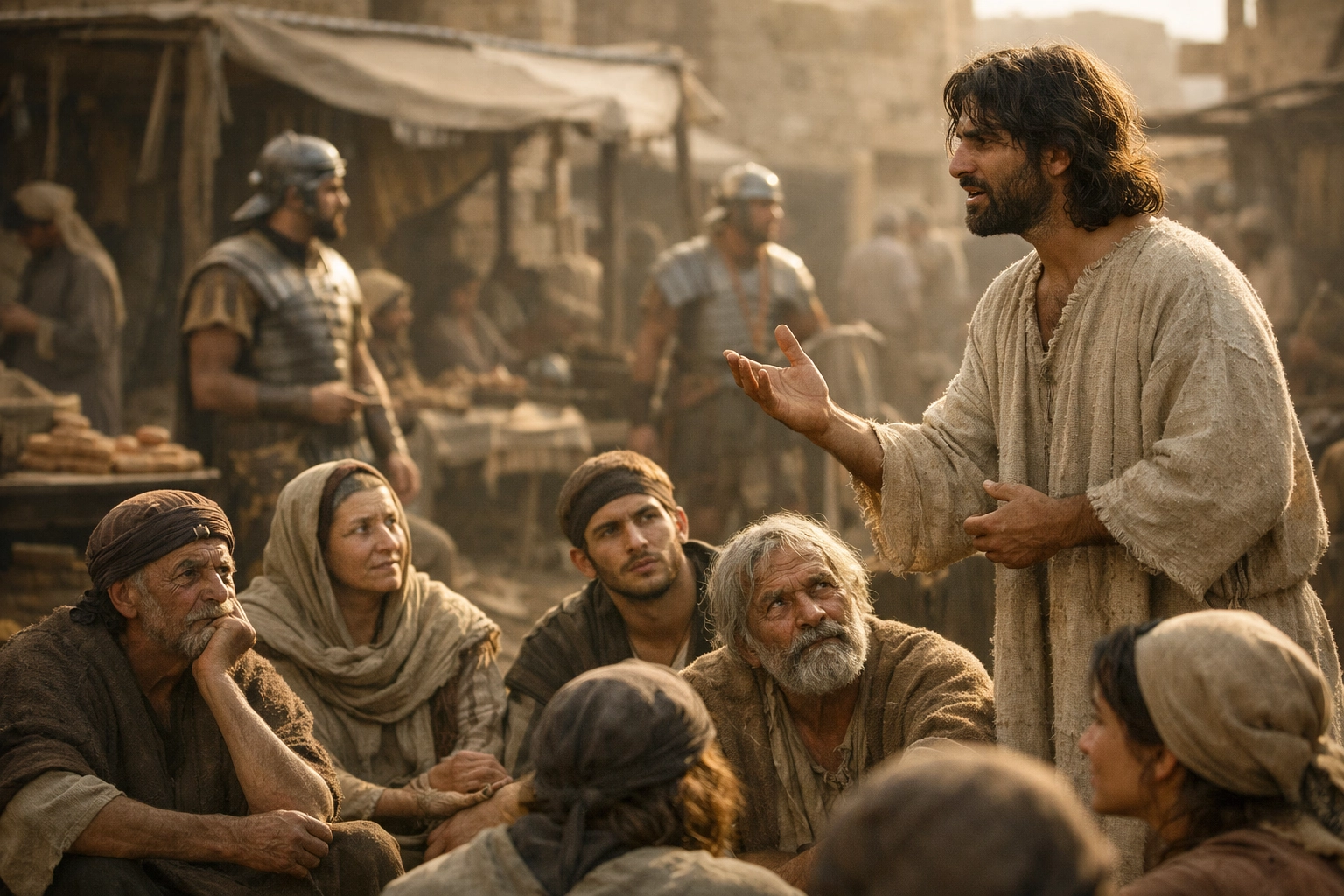
First-century Judea marketplace scene with a teacher speaking to a small crowd under subtle Roman presence, warm dusty cinematic light

This is why Metanoia (μετάνοια) still lands like a shock when you hear it the way its first audience heard it. Matthew records Jesus’ opening message: “From that time Jesus began to preach, and to say, Repent: for the kingdom of heaven is at hand.” (Matthew 4:17, KJV). The people hearing that weren’t floating in abstract spirituality. They lived with Rome in their face—occupation, taxation, the daily humiliation of being managed by someone else’s empire. Many longed for a political Messiah, a king who would overthrow Rome, reassert national strength, and put enemies in their place. So when Jesus calls for Metanoia (μετάνοια), he’s not merely asking for private remorse; he is moving the battlefield. The kingdom he announces doesn’t begin with the palace takeover they expected; it begins with an internal reorientation toward God’s reign—an overhaul of what you desire, what you trust, and what you’re willing to do to “win.” For them, the lesson was disorienting: you can’t build God’s kingdom with the same old tools of hate, domination, and payback. For us, it’s painfully current: if I think the main problem is the other side’s ignorance, I’ll keep trying to conquer people with words; but if Jesus is right, the first place the kingdom presses is the Lēb (לֵב) that wants to conquer.

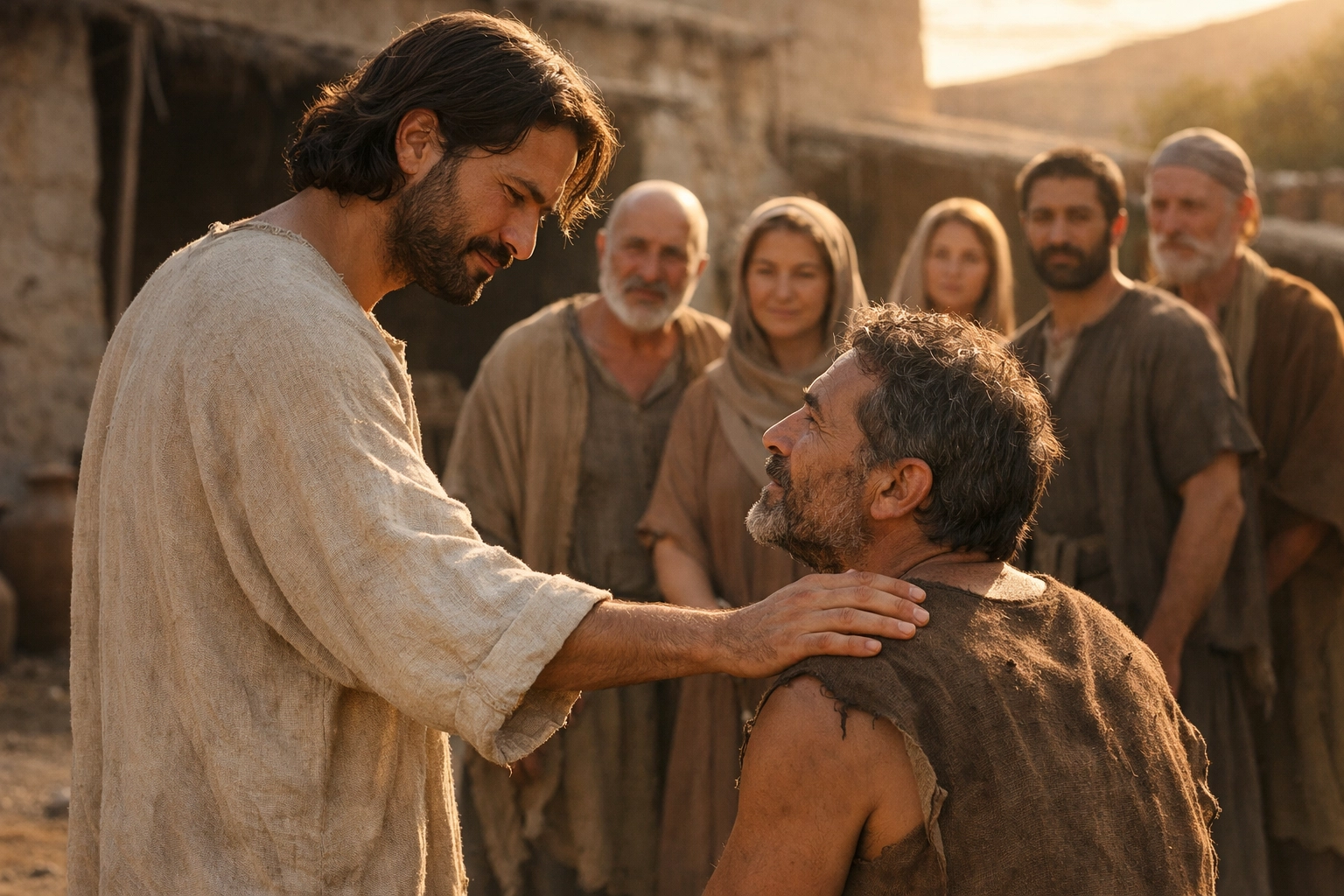
Compassionate outdoor scene with a healer figure gently touching a man’s shoulder as onlookers watch with softened expressions, warm late-afternoon light

This is also why Ephphatha (אֶפְתַּח) matters so much more than the mechanics of a miracle. Mark places Jesus in the Decapolis, a largely non-Jewish Gentile region (Mark 7:31, WEBUS), and the geography matters because it’s the kind of place where “us” and “them” lines feel obvious. Then Mark says Jesus “looked up to heaven, sighed, and said to him, ‘Ephphatha!’ that is, ‘Be opened!’” (Mark 7:34, WEBUS). The original audience for that moment—especially the disciples standing close—would have felt the boundary being crossed. Jesus doesn’t keep his mercy inside the safe borders of his people. He touches an outsider. He heals an outsider. And by speaking Ephphatha (אֶפְתַּח), he is not only opening a man’s ears; he is opening the Lēb (לֵב) of his followers to the people they would normally exclude. For them, the lesson was a re-training of instinct: the “other” is worthy of connection, worthy of touch, worthy of presence. For us, the application is uncomfortably practical: if following Jesus is making us more closed—more dismissive, more allergic to empathy, more eager to label—then we’re moving in the opposite direction of the one who sighed with compassion in outsider territory.

There’s a reason Mark includes that sigh. It’s the sound of love refusing to become numb. And that’s where “Heart Change vs. Winning” finally stops being a concept and becomes a mirror. In a culture that rewards takedowns, Jesus keeps pointing to a deeper victory: a Lēb (לֵב) that stays open without becoming naive; a tongue that tells the truth without turning it into a blade; a will that chooses the person over the scoreboard. This is the strange math of the kingdom: sometimes you “lose” the argument on purpose—not by lying or folding on what matters, but by refusing to cash in someone else’s humiliation as proof you were right—because you’re trying to win something bigger than the moment. You can win an argument and still lose yourself, because contempt is not a neutral tool; it shapes you, it trains you, it makes you smaller, and it makes everyone around you feel like a threat instead of a neighbor.

If you’re tired, you’re not alone. The exhaustion many of us feel isn’t only political fatigue; it’s spiritual fatigue—the weariness of living in a world where every conversation is tempted to become combat. The kingdom of heaven is at hand, which means your next disagreement is close enough to become holy ground. Not because you’ll do it perfectly, but because you can choose what your Lēb (לֵב) will practice: you can choose to see an image-bearer instead of a label; you can choose to pursue the kind of win that doesn’t require someone else to be reduced; you can choose “losing to win,” trusting that God does more with humility than we ever manage with dominance.

Not Left. Not Right. Anti-Hate.
It Starts With Me.

Antiha Logo

Subscribe to receive updates about our progress

Copyright 2026, Antiha.org - All Rights Reserved