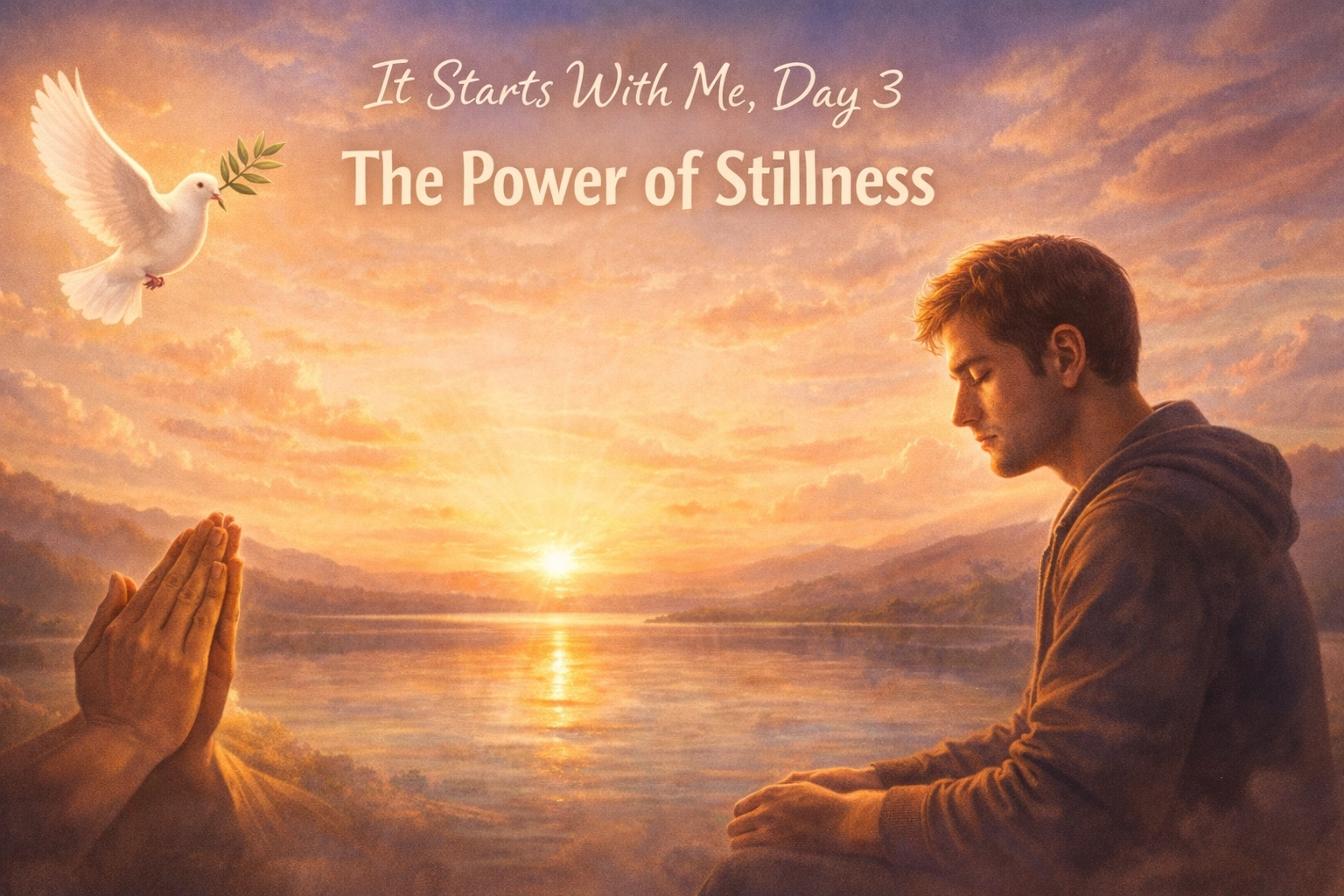
By Chris Richards
Founder, Antiha.org
Published March 10, 2026
Psalm 46:10 is not advice. It is an order from the throne.
“Be still, and know that I am God: I will be exalted among the heathen, I will be exalted in the earth.” (Psalm 46:10, KJV)
The command sounds gentle in English, but the Hebrew underneath it is not sentimental. The verb translated “be still” is raphah (רָפָה). It carries the sense of to slacken, to sink, to drop, to let go, to loosen one’s grip—language that fits a battlefield as naturally as it fits a prayer closet. In Scripture, the idea is not “find a calming mood,” but “release what you are clutching.” In a world of clenched fists—literal or digital—raphah reads like disarmament: stop tightening your hand around the weapon, stop drawing back the arm, stop sustaining the pressure that keeps violence (or contempt) in motion.
The second verb matters just as much: “and know.” The Hebrew for “know” is yada (יָדַע), which regularly describes experiential, relational knowledge, not mere information. This is not God saying, “Collect correct ideas about me.” It is God saying, “Stand down long enough to encounter the reality of who I am.” In other words: the stillness is not an end in itself; it is the posture in which trust becomes possible, because you finally stop acting like your striving is the axis the world turns on.
Day 3 of It Starts With Me is about Radical Peace under pressure—peace as worship, peace as obedience, peace as the costly act of laying down what you believe you need in order to survive the outrage age. This is not escapism. It is surrender. It is the refusal to keep participating in a war that forms your soul into the image of your enemy.
The Core: Peace and Forgiveness When the World Is on Fire
The Bible’s command to stillness is never a denial that danger is real; it is a denial that fear and rage get to rule. Psalm 46 is explicitly a war psalm—earth giving way, mountains shaking, kingdoms moved—and the stillness is spoken inside the instability, not after it.
That is why “be still” cannot be reduced to temperament management. Raphah is the command to stop sustaining your own panic-driven campaign, because God insists on being recognized as the decisive actor: “I will be exalted…” The point is sovereignty. The stillness is a confession.
This is where Antiha’s core sits: radical peace and forgiveness that do not wait for the other person to become safe, reasonable, or likeable. Not because evil is imaginary, and not because justice is irrelevant, but because Scripture is clear about what hatred does to the human heart. Rage feels like strength, yet it quietly disciples you into a mirror-image of what you oppose. Forgiveness, in the Christian sense, is not applause for the offender; it is the costly refusal to keep the offender as your inner master.
The New Testament gives language to what Psalm 46 is already demanding. When Jesus teaches forgiveness, the verb is aphiēmi (ἀφίημι)—to send away, release, let go, to cancel a debt. Forgiveness is disarmament at the level of the soul: you stop holding the claim in your fist as the thing that will justify your contempt. And this “letting go” is not separate from worship; it is worship. You are treating God as God by refusing to act like vengeance, control, and the last word belong to you.
Stillness, then, is not “checking out.” It is the disciplined choice not to be conscripted into the war of reaction—to stop striking with the only weapons the world recognizes and to trust that God’s reign does not depend on your constant retaliatory output.
The Roots: Why Outrage Feels Necessary (And Why It’s Not)
Outrage often presents itself as moral seriousness, but it frequently functions as a substitute for trust. The heart says, “If I do not stay activated, if I do not keep pressure on, if I do not fire back, then evil will win.” That internal logic feels responsible, even righteous—but it is not neutral. It is a spiritual posture. It assumes that history rests on your ability to maintain constant combat-readiness, and that your neighbor’s destruction is a form of protection for your world.
Psalm 46 diagnoses that posture by confronting it with the command raphah. The verse does not merely address external conflict; it addresses the inner compulsion to control outcomes through force—whether the force is a sword, a lawsuit, a social-media pile-on, or the quieter violence of contempt. The command to “know” (yada) exposes the deeper issue: you do not actually know God as God while you are clinging to your weapon as your functional savior. Experiential knowledge of God’s sovereignty requires the surrender of the illusion of sovereignty you have been practicing.
The Old Testament links this dynamic directly to God’s saving action. At the Red Sea, with Israel trapped and terrified, Moses declares: “The LORD shall fight for you, and ye shall hold your peace.” (Exodus 14:14, KJV) That is the same spiritual move as Psalm 46: your stillness is not the absence of conflict; it is the refusal to seize God’s role. It is trust expressed as non-grasping.
That is why stillness feels impossible when outrage has become anesthesia. Noise can keep grief at bay, keep fear unnamed, keep shame moving, keep anger feeling purposeful. Silence does the opposite: it removes the numbing agent and forces the wound into the open air. The point is not self-improvement; the point is exposure before God, because that is where healing begins. In Christian theology, God does not redeem us by keeping us stimulated; he redeems us by bringing the truth into the light and giving us himself in the middle of it.
Stillness is therefore a kind of protest, but not the trendy kind: it is protest against the world’s demand that you must always have an enemy in your sights in order to be awake. It is the decision to stop letting the loudest voices catechize your nervous system. And it is practical in the most basic way—because when the heart never slows, everything becomes threat, every disagreement becomes invasion, forgiveness sounds like surrender, and love looks naïve. Stillness does not make you passive; it makes you resistant to hatred’s formation, which is precisely the kind of resistance outrage culture cannot tolerate.
The Way: A Manifesto of Disarmament
The stillness Psalm 46 commands is not abstract. It takes flesh and walks among us in Jesus of Nazareth, who reveals what it looks like when God’s sovereignty is trusted rather than competed with. The Gospels repeatedly show him refusing the anxious scramble for control. He can sleep in the chaos, not because chaos is harmless, but because the Father is not absent. When the sea turns violent, he does not negotiate with panic; he commands the storm: “Peace, be still.” (Mark 4:39, KJV) His authority over the waters is not merely a miracle story; it is a revelation that the Lord enthroned in Psalm 46 is present in him, and therefore the command to “be still” is not naïveté—it is alignment with reality.
That alignment runs straight into how Jesus addresses anxiety and the future. In Matthew 6, he forbids the posture of fretful grasping—“Take therefore no thought for the morrow…” (Matthew 6:34, KJV)—not because needs are unreal, but because the Father’s governance is real. Anxiety is often the mind’s attempt to keep itself sovereign. Jesus calls it what it is and then redirects trust: seek first God’s kingdom, and stop pretending that your internal catastrophe-planning is providence.
This is also why the New Testament language of “rest” is not soft. Jesus invites the burdened: “Come unto me, all ye that labour and are heavy laden, and I will give you rest.” (Matthew 11:28, KJV) The noun behind that “rest” is anapausis (ἀνάπαυσις)—relief, cessation, settled rest—rest that is not mere sleep but the end of self-justifying toil. Jesus is not handing out spiritual spa coupons; he is offering the deep Sabbath reality Israel was commanded to practice: the weekly renunciation of control that declares, “God sustains the world without my frantic labor.” In that sense, Jesus does not merely teach Sabbath; he embodies it. He is the personification of the stillness God commanded—God’s own peace entering the human storm.
So “The Way” is a manifesto because it is a decision about allegiance. Disarmament is not only about what you stop doing; it is about what you are worshiping when you stop. To drop the weapon—whether it is a blade, a keyboard, or the carefully sharpened sentence you were about to publish—is to treat God’s sovereignty as more real than your need to win. It is to practice aphiēmi in real time: releasing the debt, sending away the claim, letting go of the compulsive need to punish, perform, dominate, or be seen as right.
Practically, this means you build habits that make room for obedience when you are provoked. You write the reply and then delete it as an act of worship. You close the tab that trains contempt and call it fasting, not from information but from formation. You stop defending yourself for a minute—not because truth does not matter, but because the self that must always be justified has quietly replaced God. You open your hands and say, with your body and not only with your mouth, “You are God. I am not.” That is raphah. That is stillness. That is disarmament.
This is what it looks like to follow Jesus in an outrage age: you stop fighting with the tools of hate because you have come to believe, by yada-knowledge, that God does not need your violence to be exalted.
The Call: Raphah. Today.
Psalm 46:10 does not leave room for a polite, theoretical response. The command is present tense: be still—release your grip—and know—encounter, recognize, submit to the reality that God is God. That is why enemy-love collapses when we run on fumes, yes, but also why it collapses when we keep insisting on playing God. The call is not to “feel calmer.” The call is to worship by surrender.
So make the command concrete in the place where you are most armed. Choose one act of disarmament that costs you something real: delete the post you were about to fire off; refuse the comment that was meant to cut; stop the “just sharing” that functions as gossip; release the compulsion to manage your image; relinquish the need to have the last word. Then stay in the quiet that follows long enough for the truth to surface—what you were trying to protect, what you were trying to control, what you were trying to punish—and give that to God without bargaining.
This is not how hate loses ground in headlines; it is how hate loses ground in a human heart. And hearts are where communities either heal or keep bleeding.
It Starts With Me.
Not Left. Not Right. Anti-Hate.