Day 2: Faces Over Labels
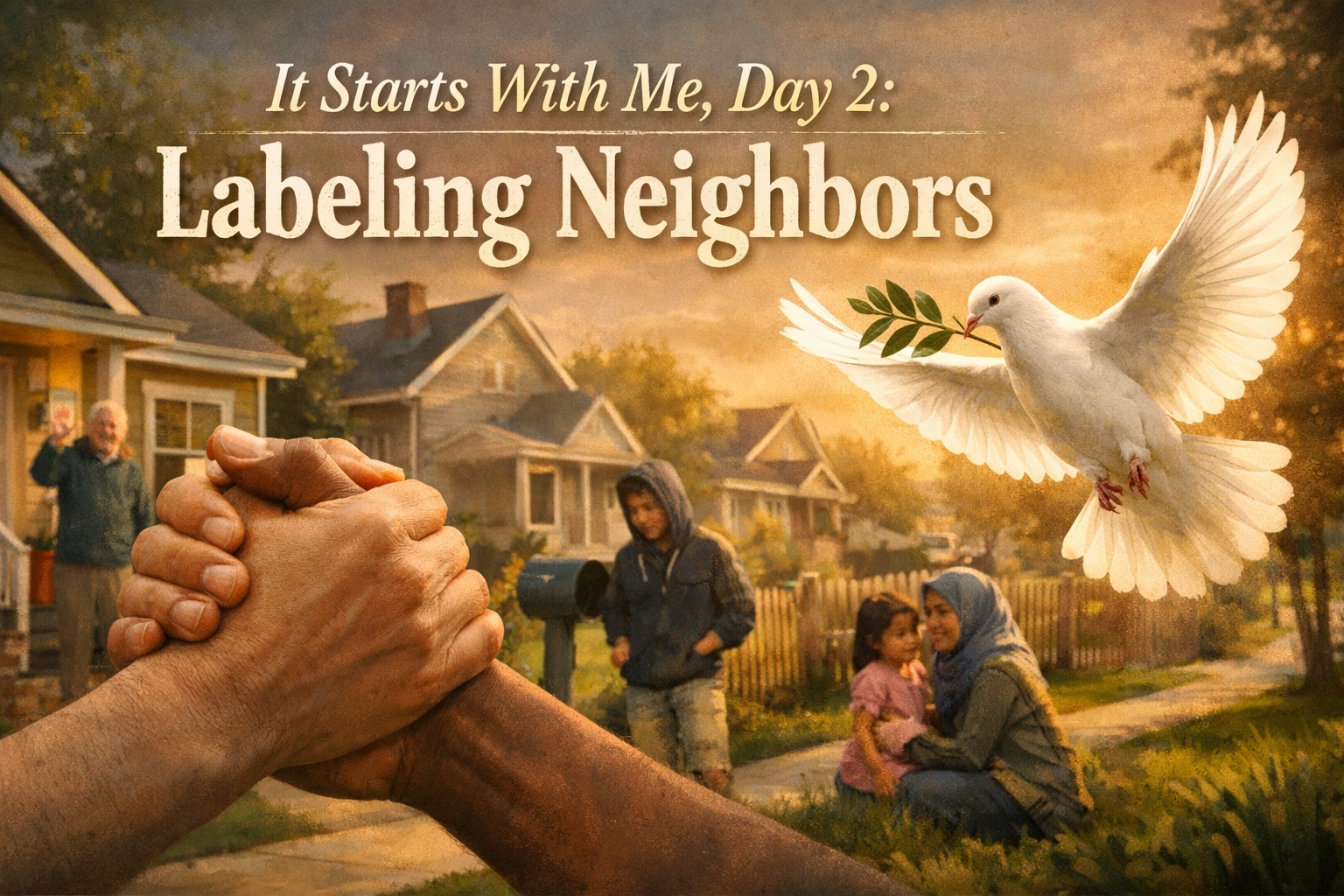
By Chris RichardsFounder, Antiha.org
Published March 9, 2026
Hey there, I’m Chris. Welcome back to Day 2 of our “It Starts With Me” series. If you joined us for Day 1, you know we’re trying to move past the noise and get back to the heart of what it means to follow Jesus in a world that feels increasingly divided.
Yesterday, we talked about the internal shift: peace doesn’t start with “them” changing; it starts with us. Today, we’re taking that a step further with a practice that’s simple to say and honestly hard to live: Radical Peace means choosing faces over labels.
Have you noticed how fast we categorize people? You see a post, glance at a profile pic, read a three-word bio, and boom—they’re a type. “Woke.” “MAGA.” “Legalist.” “Heretic.” “Elite.” “Backwoods.” We do it because it’s efficient. Our brains love shortcuts.
But here’s the cost: when we label people, we stop seeing their humanity. We stop seeing a person and start seeing a category.
Jesus calls us the other way around—to see the person instead of the label. To see someone made in the image of God (Imago Dei), not a walking stereotype. Because once someone is “just a label,” it gets weirdly easy to dismiss them, mock them, or even hate them… without ever noticing we’ve done it.
The Shortcut that Short-circuits Peace
Ever wonder why labeling feels so automatic? Psych folks call it “social identity theory.” In normal life, it’s one way we sort the world: us/them, in/out, safe/unsafe. It can be a survival mechanism.
But spiritually? Labeling becomes a wall. Because if I can label you as “The Enemy” or “One of Those People,” I don’t have to listen. I don’t have to understand. I don’t have to carry your burdens. And (if we’re being honest) I don’t have to love you.
Fun Fact: The New Testament word for “neighbor” comes from the Greek plēsion—literally, “the one who is near.” Not “the one who agrees with you.” Not “the one who votes like you.” Not “the one who posts the right things.” The one who is near. The person in front of you.
So when we label someone, we create distance. We move them from plēsion (near) to an abstraction (far). We stop seeing the dad trying to keep it together for his kids, or the woman grieving her mom, and we only see “Socialist,” “Nationalist,” “brainwashed,” “dangerous,” “ignorant,” whatever.
The Jesus Way: Faces First
What did Jesus do when someone had a label stuck to them? He walked straight toward them.
Jesus was the ultimate label-breaker. Think about the people He spent time with: tax collectors (traitors), zealots (political radicals), prostitutes (social outcasts), and Samaritans (ethnic and religious enemies).
In Jesus’s day, these labels weren’t just spicy opinions; they could decide your social standing—or your safety. A Roman centurion? “Oppressor.” A leper? “Unclean.”
But Jesus looked past the category every single time. He didn’t see “Oppressor”; He saw a man with a sick servant and unexpected faith. He didn’t see “Unclean”; He saw a person who needed a touch.
That’s the heart of Radical Peace: seeing a face where the world hands you a label.
So here’s a real-life gut-check: What label am I putting on this person right now to make it easier to dismiss them? And right behind it: What might I notice if I chose to see them as a person Jesus loves?
Who is My Neighbor? (Faces Over Categories)
Ever notice how we love the idea of love… until we have to define who qualifies? One of the most famous stories Jesus ever told started with a lawyer looking for a loophole in the command to “love your neighbor.” He asked, “And who is my neighbor?” (Luke 10:29).In other words: “Where’s the line? Who can I stop loving?”
Jesus answers with the Parable of the Good Samaritan—and the point lands harder when you remember: for a 1st-century Jew, “Samaritan” wasn’t a neutral descriptor. It was the religious and ethnic “Other.” The group you avoided. The label you didn’t redeem.
In the story, a man is beaten and left for dead. Two religious leaders—the “right” kind of people with the “right” reputations—walk by and do nothing. Then the Samaritan—the “wrong” person with the “wrong” label—stops. He treats the wounds. He lifts the man up. He pays for his care.
Jesus flips the question. He doesn’t define “neighbor” by the injured man’s category. He defines it by the rescuer’s compassion.
Radical Peace looks like this: when a face is in front of you, the label loses its power.
Radical Peace in Real Life: Humanizing the “Other”
Ever wonder why conflict escalates so fast online (and even in person)? One reason is that labels make people feel far away—like they’re a concept, not someone with a body, a story, and a nervous system.
Here’s a simple definition worth keeping: - A label reduces a person to a category. - A face reminds you there’s a whole human there.
And this is where Jesus keeps pulling us back. Not to “win,” not to “clap back,” not to score points—just to love our actual neighbor. The one who is near.
So if you find yourself thinking, “I can’t stand those people,” try swapping the phrase for something more honest: “I’m struggling to love this person.” That little shift moves you from ideology back to discipleship.
If you’re tired of outrage culture and want to practice Jesus-centered peacemaking with us, Antiha’s here—no gatekeeping, no ‘you must agree with everything first’ energy. Just a shared commitment to the way of Jesus: radical love, peace, and forgiveness.
Practical Steps for Radical Peace
So, how do we actually stop labeling? How do we live out "It Starts With Me" on a Tuesday afternoon when someone cuts us off in traffic or posts something inflammatory online?
1. Catch the Label in Real-Time: The next time you feel a surge of anger toward someone, pause. Ask: "What word did I just use to describe them in my head?" If it was a political or social label, try to replace it with "Neighbor" or "Child of God."
2. The 3-Question Rule: Before you respond or dismiss someone, try to answer three questions about them: - What might they be afraid of? - What do they love? - What is one thing we probably agree on (e.g., "We both want our kids to be safe")?
3. Humanize the Screen: Remind yourself that there is a nervous system, a heartbeat, and a life story behind that avatar. Humanizing the 'other' behind the screen is a spiritual discipline.
4. Choose the Neighbor Over the Label: In every interaction, ask yourself: "Am I treating this person like a category, or like a neighbor?"
It Starts With Me (Yep, Still)
Ever feel the pull to say, “Yeah, but they started it”? Same. And this is where Jesus’ way gets real: Radical Peace starts with what I do when I’m tempted to reduce someone to a label.
Dropping labels isn’t “peace at any cost,” and it’s not being wishy-washy about convictions. It’s choosing a deeper conviction: loving like Jesus, even when it costs you pride, comfort, or the feeling of being superior for five seconds.
At Antiha, we believe this kind of peace is possible—not by sliding Left or Right, but by moving toward each other, centered on the way of Jesus.
If you want to keep going with the 7-day journey, the full series is here: https://antiha.org/it_starts_with_me.html.
Let’s commit today to seeing faces over labels. It’s slower. It’s more vulnerable. And it’s how healing starts.
See you tomorrow for Day 3.
It Starts With Me.Not Left. Not Right. Anti-Hate.
But Jesus looked past the category every single time. He didn’t see “Oppressor”; He saw a man with a sick servant and unexpected faith. He didn’t see “Unclean”; He saw a person who needed a touch.
Dropping labels isn’t “peace at any cost,” and it’s not being wishy-washy about convictions. It’s choosing a deeper conviction: loving like Jesus, even when it costs you pride, comfort, or the feeling of being superior for five seconds.